


Most MIG welding defects come from setup, technique, or material preparation.
The Problem
Issues like porosity, lack of fusion, burn-through, and feeding problems can reduce weld strength and appearance.
The Straight Answer
Fix the root cause—gas coverage, heat input, travel speed, or wire feeding—before adjusting everything else.
Common MIG Welding Defects
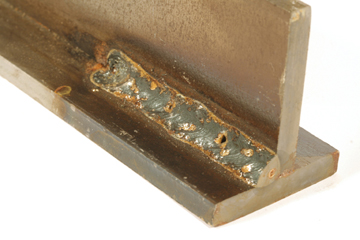
Porosity
Small holes in the weld caused by gas contamination.
- Poor shielding gas coverage
- Dirty base metal
- Wind or drafts
- Leaking hoses or liners
Aluminum is especially sensitive due to oxide buildup and contamination.
Lack of Fusion
Weld metal does not fully bond to the base material.
- Low voltage or amperage
- Travel speed too fast
- Poor heat input
Craters
Depressions at the end of a weld that can lead to cracking.
- Stopping without filling the weld
- Improper technique at the end of the bead
Burn-Through
Excess heat melts through the material.
- Voltage too high
- Travel speed too slow
- Thin material
Aluminum is more prone due to its low melting point and high heat conductivity.
Wire Feeding Problems (Birdnesting)
Wire tangles at the drive rolls, stopping the weld.
- Soft aluminum wire
- Incorrect liner or drive rolls
- Poor tension settings
Feeding aluminum is often compared to pushing a soft wire through a tube—it requires proper setup.
Aluminum-Specific Challenges
- Higher heat conductivity
- Lower melting point
- Oxide layer contamination
- Wire feeding difficulty
These factors make aluminum more sensitive to defects than steel.
Equipment Matters
The right equipment helps prevent defects before they start.
- Spool guns reduce feeding issues
- Push-pull systems improve consistency
- Modern machines allow better heat control
Troubleshooting Common Issues

Voltage too low: Poor penetration, convex bead, spatter

Amperage too high: Wide bead, burn-through, distortion

Amperage too low: Narrow bead, poor tie-in

Travel speed too fast: Poor penetration, narrow bead

Travel speed too slow: Excess heat, distortion

Voltage too high: Unstable arc, poor penetration

Shop Tip
If your weld looks wrong, stop and check one variable at a time.
Changing everything at once makes it harder to find the real problem.
Bottom Line
Most MIG welding defects are preventable with proper setup, clean material, and consistent technique.
Fix the cause, not just the symptom.
Comments
Please sign in to leave a comment.